
On Cliffhangers
Are you hanging on?

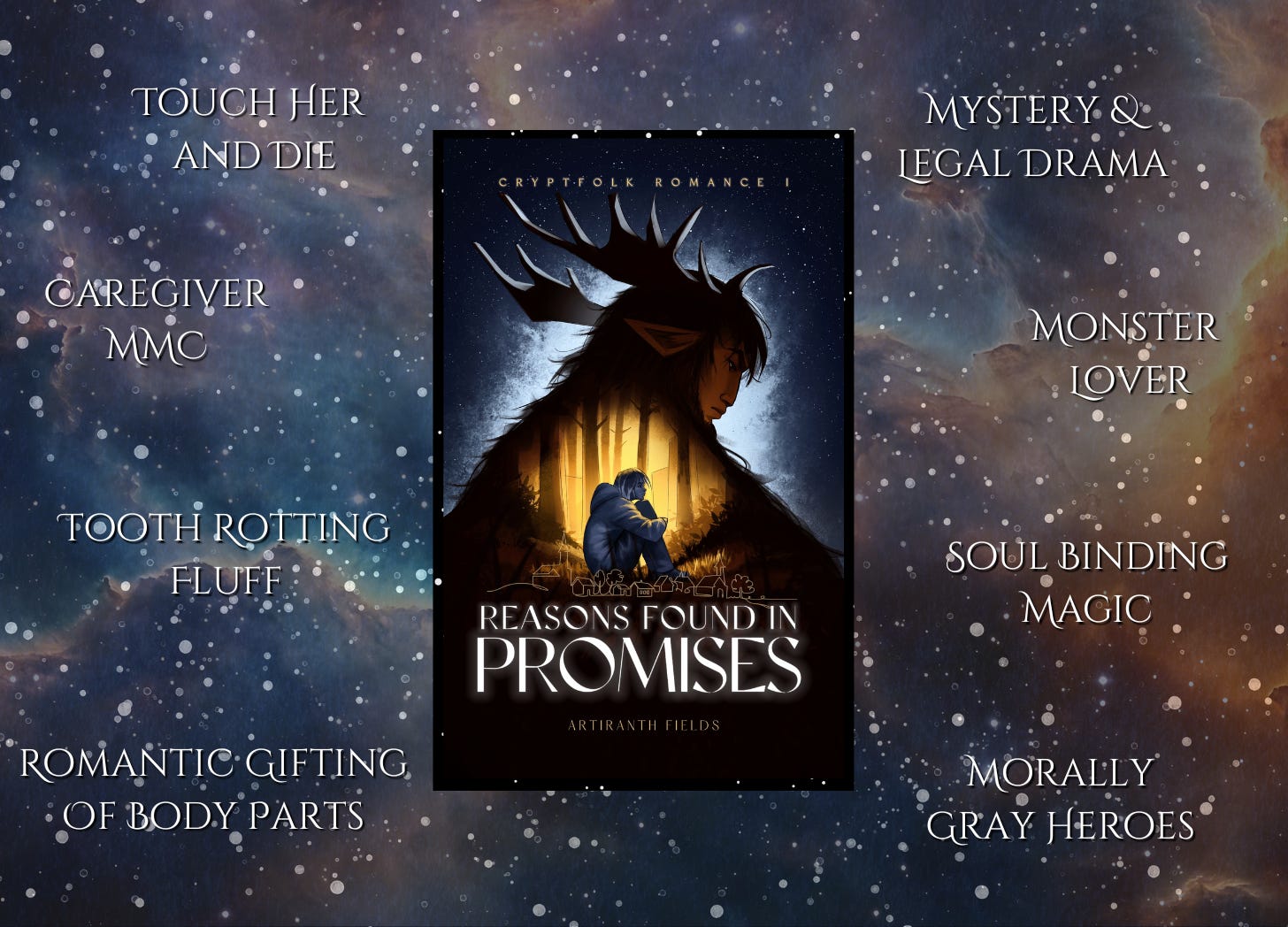
Hello all! If you have not picked up your copy of “Reasons Found In Promises” consider doing so today!
Announcement:
I will start linking my Etsy shop here as well. All the designs are drawn by me, no AI. I use Printify to have them printed on demand on various products. Hoodies, backpacks, phone cases, etc. The library is small at the moment, but will increase with time. I will also be doing “Reasons Found In Promises” inspired merch using the cover art for both the old and new cover, and making some of my own.
So, I will be adding a section at the end of the newsletters where I showcase a design or item! I will also take requests in the sense of if there is an existing design on my shop but you would like it on another product, I can make those and post them for general purchase.
On to the meat and potatoes of this thing.
Where it started:
This article is coming from a personal, deep-seated, and maybe a little bit irrational hate for cliffhangers.
I DESPISE THEM.
In almost any media, but books especially so. That eventually led me to make this post on Reddit.
Which… was interesting.
Because it brought out quite a few others who also voiced their dislike for cliffhangers, some even went into what they liked and didn’t like about them. A few did come out to defend them, but with various caveats and “only ifs.”
This led me on a bit of a thought spiral about cliffhangers and the culture of them in media. As “leave it on a cliffhanger” is actually a VERY common piece of not just writing advice, but one across pretty much any entertainment medium.
Why I hate cliffhangers
So at this point you might be wondering: Arti, why do you hate cliffhangers so much?
Because they put me off most stories. As in, if a book ends on a cliffhanger, especially a “surprise” cliffhanger, I am far less likely to pick up the next one.
To me, it’s the experience of going into a fancy Italian restaurant and asking for a Chicken Parmesan Pasta. A cliffhanger to a book is like a Chicken Parm without the mozzarella, and then the owner apologises profusely and tells me that next time I order, they will give me extra mozzarella.
All as a cheap ploy to get me to come back and pay for the same meal again.
At best, it gives me a net neutral feeling. Like I ate it, it was fine; when I happen to be in the area, I might go to the restaurant again if I remember it exists. At worst, it’s unsatisfying, and I will blacklist the place as a whole because it’s a waste of money.
In other words: if I am unsatisfied with this book, why should I trust the next one to not end on a dissatisfying note? Basically, I get really bad negative cliffhanger hangovers. They don’t make me rush to the bookshop to get the next one; they make me put the book on my shelf and never pick it up again.
Now, funny enough, this is only an issue when I don’t have the next thing in front of me. If, say, I buy the whole trilogy and can binge the whole thing, I don’t have a problem. Because then I can read it as one continuous narrative. But at that point, it’s not really a cliffhanger.
Same thing with shows and movies. Although I am more lenient with them, when an episode or even season ends on a cliffhanger, it never gives me a “I want the next one”; it leaves me angry and frustrated. Like I wasted my time.
Meanwhile, stories that end, that have a conclusion, even if there are loose ends that can be tugged on and explored later, but there is an overall end to the narrative of THIS story — I absolutely want more of. Going back to the Chicken Parm analogy, it’s like going to a restaurant and getting a completed dish with all the ingredients and it’s satisfying. Then, I can talk about how good the Parm was, and how much I wanna go back there to have it again. And maybe next time they have a special I’d be willing to try because the first time was so good.
They make me want more.
The Author Versus Reader
I think I may make this a series because it’s becoming a theme of my bigger articles. But, once again, I want to talk about the different perspectives and outlooks authors have, or are being pushed towards, versus readers.
The thing is, authors, of any media really, are encouraged to have cliffhangers. Some say as often as every chapter. Others just at the end of books that are part of series. But the consensus remains the same: cliffhangers are a way to keep your audience engaged.
Articles like this one dominate the author space as crucial points of advice to keep people reading your stories.
Yet, I and quite a few people who came out of the woodwork on the post have the exact opposite reaction to them.
This may be another case of a vocal minority. As in, we, the cliffhanger-haters, are vocal about our hate. But the industry speaks with the dollar signs and views attached to the silent majority that keeps buying the next installment. If cliff hangers didn’t work, the obvious marketing advice wouldn’t be to have them. That wouldn’t make sense.
We could leave it at that.
But I posit that the dichotomy goes further, and has to do with how authors think they need cliffhangers, while readers as a whole are more ambiguous on the topic. And that there is a difference between “mini” cliffhangers and the large ones at the end of books.
The Myth of the “Good” Cliffhanger
You may ask: well, what if it is done well?
And my hot take is there is no such thing as a “well-done” cliffhanger.
To preface, this doesn’t mean you should never use a cliffhanger, or that there isn’t some merit to them, or that they don’t work.
All I am really saying is they are inherently a tool with a purpose whose goal is not narrative satisfaction, completeness, or elevation. They are tools in order to do the exact opposite, in order to secure sales of the next thing with the promise of pay-off. They are MEANT to leave the story open, without a narrative end, and feel unsatisfying—to itch at you until you just can’t fucking stand it anymore and gotta go get the next book.
So yes, you could argue that a cliffhanger that succeeds in this regard is a “good” cliffhanger. But my return to that is: you succeeded in selling the next book by making your ending purposefully worse. You are the restaurant owner, jipping me of my mozzarella, in the hopes that the promise of it next time will get me to come back. That doesn’t mean your mozzarella was good; you didn’t give it to me in the first place.
Would you ever call that good service? No.
You can maybe call that good marketing... if it works.
Other Boons of Not Hanging On Cliffs
Something that got brought up on the Reddit post that I actually didn’t think about before is the retention of people after a long break.
Although cliffhangers may be meant to keep you guessing, it is actually much harder to get into the next book when it ends on a cliffhanger. I am sure we have all experienced it: awaiting the next book for years, only to pick it up and realise you have no idea what is going on in the first pages. Forcing you to re-read the previous thing before continuing.
This is because by their nature cliffhangers are incomplete scenes. As such, when one leaves on a cliffhanger, in most cases one must also BEGIN on the same cliff, hanging on for dear life, and trying to explain how they got there without losing the tension. It forces the story to start in the middle of itself, which often creates a very easy transition when the next book is right there, but a very hard one when it has been a while and you have to wait for the next one.
Books that don’t end on cliffhangers, on the other hand, have the luxury of starting the same as any other book. At the beginning of THAT story. You can set the scene. Get the reader naturally caught up with everything in a way that doesn’t make them pull up SparkNotes. This is because the inciting incident is actually in the book you are currently reading, not the previous one.
I also argue that it makes you an author who keeps their promises, which allows readers to trust you and your marketing. This leads to better relations with your audience and an overall healthier community.
When Cliffhangers are Good To Have
Now, despite brutally hating on cliffhangers at every angle, I keep saying that I am not, in fact, arguing for their extermination.
So this is about that.
I am one of many readers and writers. And as the Reddit post, and the majority of the market show, many people like or are just fine with cliffhangers. At the end of the day, as long as you market your books properly without deceptive labels, write what and however you want.
Personally, I think cliffhangers are good as smaller pieces of storytelling, like between chapters. I often leave my chapters on a bit of a hanging thread in order to push the momentum of the story forward despite a distinct “end” to the scene sequence itself.
They can also be effective as actual story ends when that narrative supports that. A famous one that I recently rewatched is the movie “Inception,” which ends on the depiction of the spinning top that we do not see drop or keep going. That is a cliffhanger ending… meant to be the ending. It leaves room for speculation of the scene, the meaning, the movie itself.
Lastly, I think there is merit to a “semi-cliffhanger” at the end of connected books. What I mean is an ending that fully resolves the main conflict of this story, but leaves glaring holes or loose threads. Specifically WITHOUT tacking the inciting incident of the NEXT book at the end of the first.
Some of the best long series of our times do this pretty much every single book. Harry Potter, regardless of how you feel about the author, is some of the best examples of this. With Harry and the gang going through a full story, with its own conclusion, in every. Single. Book. But with leftover questions and plot lines for the next one. Percy Jackson. Twilight. All function the same.
Ending Thoughts
That is it for this huge rant about cliffhangers. As a reader, how do you feel about them? Love them? Hate them? Does it depend?
As an author, do you view cliffhangers as a necessary evil of your writing or are you excited about putting them on the page? Did you ever consider that perhaps there are those who would not view the cliffhanger as a boost into the next story as you thought it did? Does it matter to you?
Feel free to discuss and tell me how wrong I am in the comments!
Upcoming Post
I am hoping to be making the beta reader wanted annoucement for “Soultrapped” in the next couple weeks.
In the meantime however, I am working on another longer post about prologues!

As a reader/viewer (because I am lumping television with books here) I find cliffhangers at the end of the book or season will get me to roll my eyes, gesticulate, and utter words of discontent. One major issue is if the story is new and the next instalment is not guaranteed, I will feel very unfulfilled and see only wasted potential. I will warn other people off of it if never fulfills its promise.
Another reason I dislike it is for the very reason that it *is* a marketing ploy. The moment someone starts using marketing tactics like this on me, I feel they are no longer seeing me as an individual, thinking person worthy of respect, but one of a dumb, voracious mass. An other. A concept. Let your story's ending recommend itself. The writer (or marketer leaning on the writer) may see me as a thing to be handled and manipulated, I see them as someone without confidence in writing a proper ending and needing to trick me, the reader/viewer into wanting more.
I am tolerant, of course, of chapter end (or episide end) cliffhangers. Sometimes they can be enjoyable when used with discernment and not every single chapter. Since I don't binge read, I like chapter ends to usually be a nice, tidy, stopping point. I am not a sultan who is going to kill you if you can't keep me hooked, so no need to leave me hanging every night.
As an author, I see them as a cancer infecting too much media, and am hoping I can be strong enough to withstand.
I enjoy an open ending that open up new possibilities, but puts the current story to rest. For example, in my story, The Illusion of Freedom, there are still a lot of unanaswered questions, and you get the sense the protagonist is moving on to a new life and a new challenge, but the story promised at the onset is delivered.
---
Thank you for the article and I am glad to know there are others who dislike cliffhanger endings to novels/movies/seasons as well. Perhaps not withthe vigour you express your distaste, but they do have the oppposite intended effect on me.
Funny you bring this up.
One of the reasons I'm considering not serialisng anymore and going the self-publish route is because of the expectation all (most) chapters end on a cliff-hanger for a serial to keep the readers coming back week to week. Maybe I'm taking what a cliff-hanger is too literally in that sense-but I don't think my chapters do this-they just wrap up the scene. There'll be threads to keep the story going, and some chapters-the bigger moments-have the cliff-hanger end of scene. But not all of them. So it made me question would I lose readers of a serialised fiction without this. I also don't want to rewrite what I have just to force them in for the sake of it.